Intro to Statistical Learning
Grayson White
Stat 243
Week 1 | Fall 2026
Goals for Today (and next time)
Today:
- Getting started in Stat 243
- Course structure and technologies
- Where to find resources
- Course expectations
Wednesday:
- Activity
But first, let me quickly introduce myself…
…and after that I’ll have each of you introduce yourselves 😄
My info
Name: Grayson White (he/him), you can call me ‘Grayson’
Email: gwhite@reed.edu
Office: Library 386
Office hours: TBD, please fill out the office hours survey ASAP for your availability to be considered.
- This week, I’ll hold office hours on Tuesday 1pm - 3pm and Friday 9am - 10:30am, or by appointment.
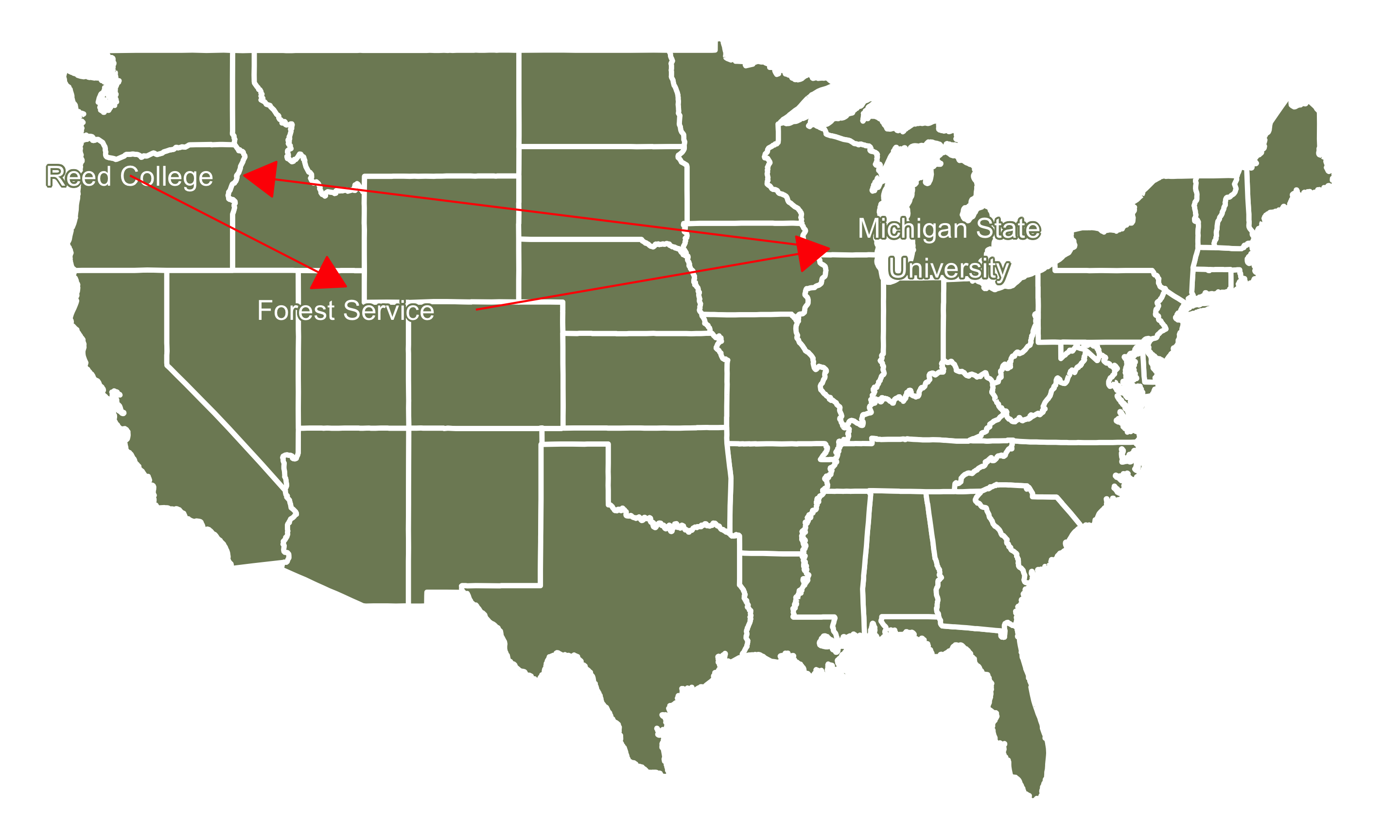
Let’s start with my path (back) to Reed…
Research Interests
Statistical modeling with environmental applications
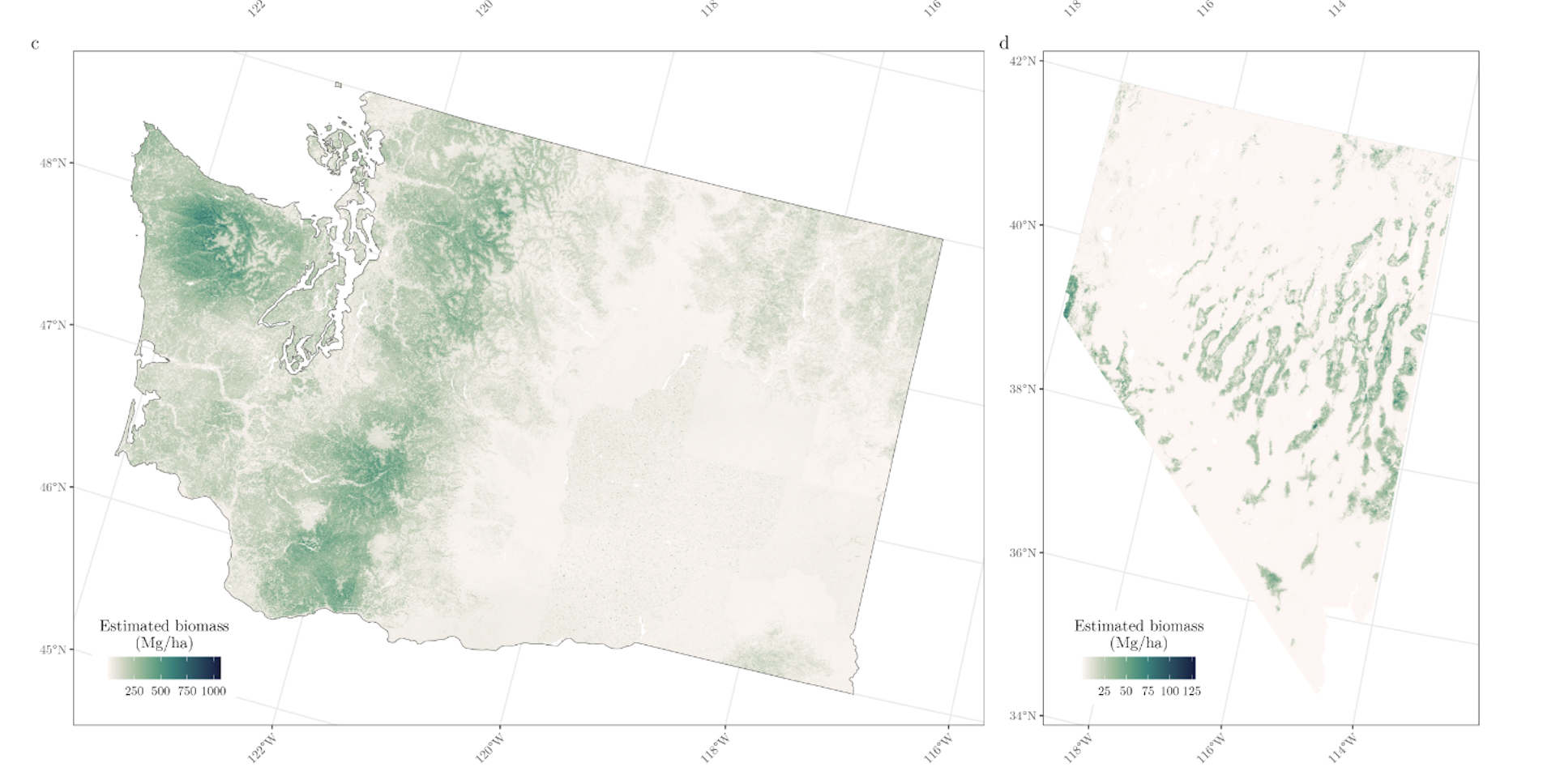
Research Interests
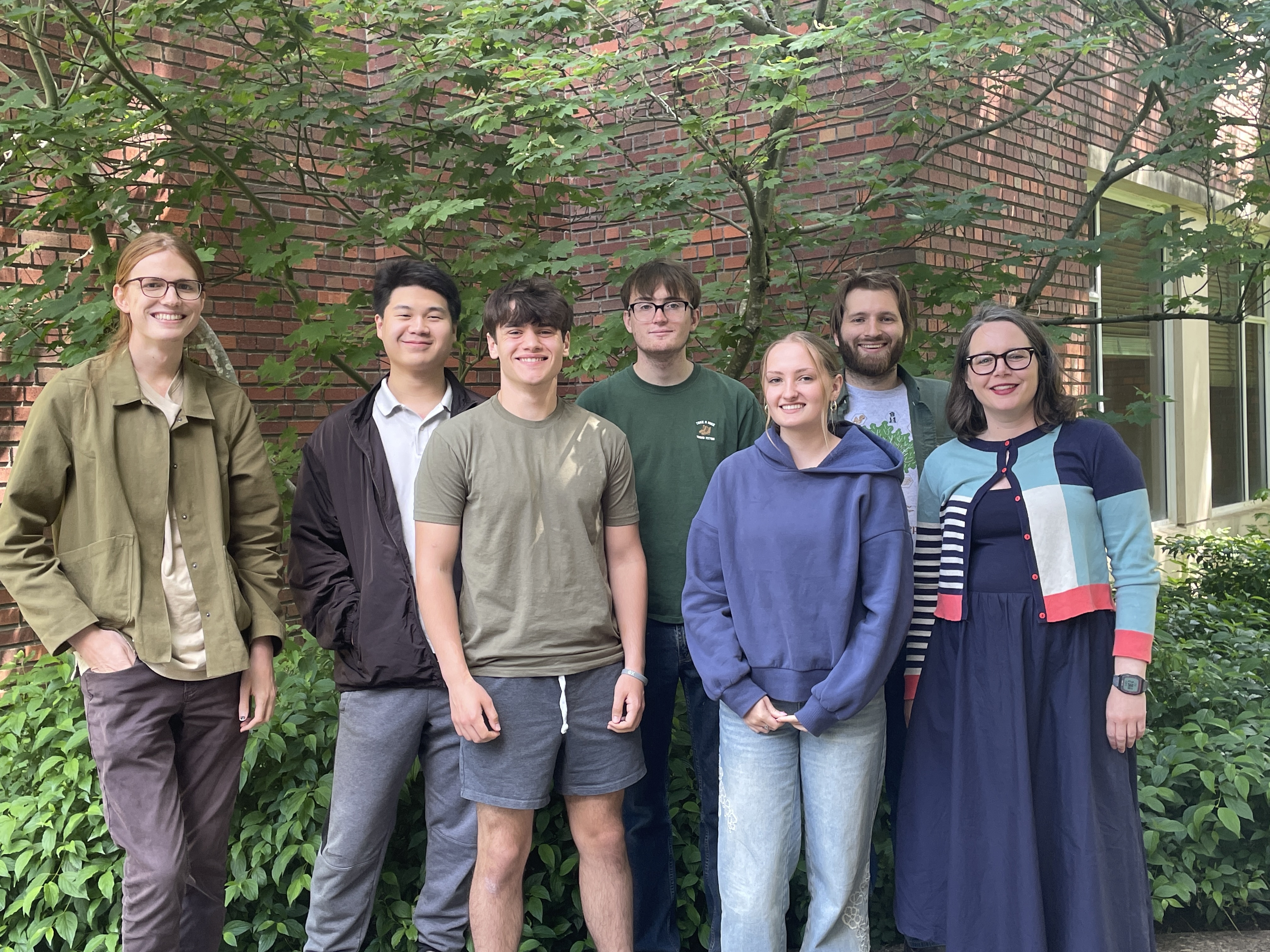
Advising Undergraduate Forestry Data Science Research
Introductions!
Would love to hear: your name, pronouns, major, what you’re excited about in this class, and a fun fact!
What is 243?
This course will:
- In a nutshell: Expand your “toolbox” for analyzing large, modern, and complex data
Cover important modeling and predictive techniques (e.g., regression, classification, clustering, tree-based methods, neural networks)
Practice each method in
Rusing real/simulated data
See syllabus for more detailed learning outcomes
Getting Started in Stat 243
Course website
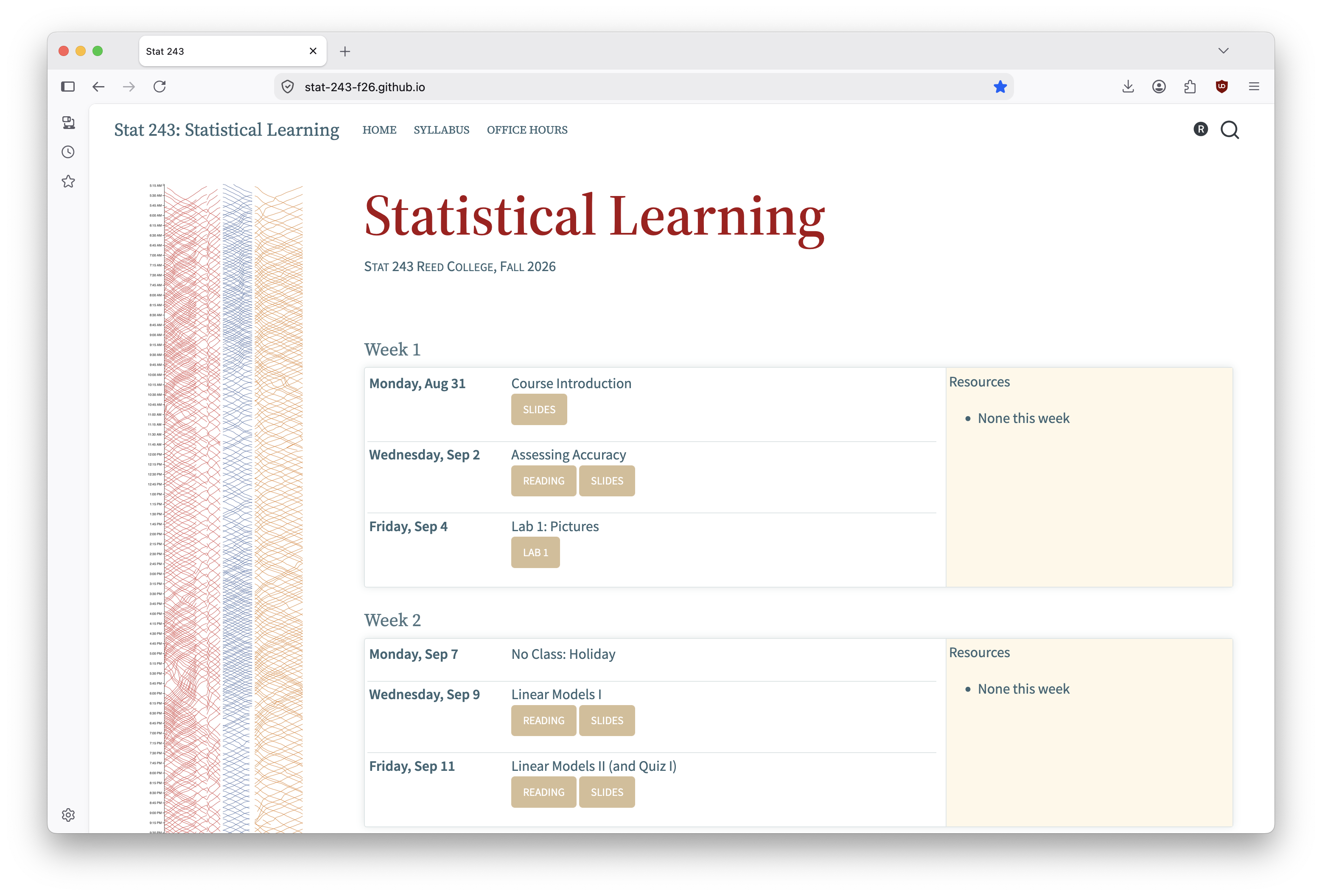
The course website, stat-243-f26.github.io, will be the central location for all our course materials.
We’ll also use some other technologies and resources for collaboration, dissemination, and communication.
Getting Started in Stat 243
Other Resources
Reed’s RStudio Server or a local installation of RStudio, for completing coursework,
A course-wide Slack workspace, for course communication,
Gradescope, for turning in assignments and exams, and
Our course GitHub organization, for collaboration, portfolio-building, and dissemination of work.
Let’s take a look at the course website…
What is Stat Learning?
Example: Loan Default
A bank wants to model the probability customers default on a loan
Common Considerations:
Customer age
Marital status
Income
Q: What other factors might a bank consider?
Q: How might each factor relate to probability of default?
Q: What ethical problems might be present?
The Setting
Let:
- \(Y\) be a “response variable” (e.g., prob of default)
- \(X_1, \dots , X_p\) be \(p\) “predictor variables” (e.g., age, marital status, income)
Stat Learning: the study of the relationships between predictors (\(X_1, \dots , X_p\)) and a response (\(Y\))
- (Sometimes we study the relationship among only predictors)
Models
We usually assume there is a relationship between predictors and response:
\[ Y = \underbrace{f(X_1, \dots, X_p)}_{\text{function of predictors}} + \underbrace{\epsilon}_{\text{"error"}} \]
where \(\epsilon\) (“epsilon”) is a random error (more on this later!)
Example: Linear regression!
\[\text{Default Prob} = \beta_0 + \beta_1\text{(Age)}+\beta_2\text{(Married)} + \beta_3\text{(Income)} + \epsilon\]
The goal of stat learning is to estimate \(f\), given data on \(X\) and \(Y\).
- \(f\) captures the “relationship” between \(X\) and \(Y\)
Types of Statistical Learning
It’s helpful to distinguish different types of statistical learning.
On the next 4 slides, I’ll contrast the following 4 pairs of terms:
Prediction vs. Inference Tasks
Parametric vs. Non-Parametric Methods
Supervised vs. Unsupervised Learning
Regression vs. Classification Problems
Prediction vs. Inference
Prediction
- Goal: Use a model to make predictions for new data
- Example: Predict probability of default for a new customer
Inference
- Goal: Understand relationships among predictors/response
- Example: What’s the general relationship between age and loan default?
- Example: Is marital status an important predictor of loan default?
Parametric and Non-Parametric Methods
Parametric Methods
Make assumptions about form of \(f\) using parameters
Example: Linear regression \[f(X) = \beta_0 + \beta_1X_1+\dots+\beta_pX_p\] where \(\beta_0,\beta_1,\dots,\beta_p\) are parameters
Non-Parametric Methods
Forgo assumptions on the shape of \(f\)
Examples: Neural networks, “nearest neighbor” algorithms
Problems: Require much more data, uninterpretable, not generalizable (more on this later!)
Supervised vs. Unsupervised Learning
Supervised Learning
Models with response variable (and predictors!)
Example: Predicting default risk using age
Unsupervised Learning
Models with no response variables
Cluster or detect pattern among observations
Example: Create “social groups” among bank customers using age and income (such as “wealthy Millenials”, “low-income retirees”, etc.)
Regression vs. Classification Problems
Regression Problems
Models with quantitative response variables
Example: Model probability of wildfire by temperature
Classification Problems
Models with qualitative response variables or outputs
Example: Predict if there will/won’t be a wildfire by temperature
Now, let’s discuss course structure and policies
Class Time
Lecture: Mondays and Wednesdays
Complete a reading before each “lecture” from one of our textbooks, An Introduction to Statistical Learning in R (ISLR), or Beyond Multiple Linear Regression (BMLR).
Occasionally, I might assign a blog post or reading from a different (free, online) textbook.
Our textbooks are free online! See the syllabus!
Lab: Fridays
Practice course content, work on assignments, and take short quizzes on past material.
Mix of pen-and-paper work, coding activities.
Typical Friday workflow: start with a brief quiz on last week’s material, then transition to practice of current content.
Technology
You will need access to a laptop for this course.
Bring a laptop to class every day
Please let me know ASAP if you do not have access to a personal laptop!
We will regularly use the R programming language
All assignments will be completed in
RStudioRStudiocan be downloaded to your computer (see syllabus) or accessed on the ReedRStudioServer: https://rstudio.reed.edu/
Assignments and projects
- Labs (weekly-ish)
- Assigned Friday at class time.
- Due the following Friday on Gradescope before class.
- Graded for completion and effort.
- Planning on 10 labs. Subject to change by \(\pm\) 1 lab.
- Each week, we will have a quiz, graded for correctness on the past week’s lab.
- Final Project
- The proposal for the final project will be due before fall break.
- More info to come!
- Final Exam
- We will have a final exam during finals week.
- In-class activities (semi-regular)
- Individual activities.
- Group activities.
- Attendance and active participation
- Is key to your learning!
- Please participate in class and in Slack.
- And will be considered in your final grade.
- Let me know if you cannot make it to class for health reasons or otherwise! If you are experiencing extenuating circumstances that inhibit your ability to attend I will work with you to help you succeed in the class. Communication is key.
Late Work
- Labs: up to 4 extensions days can be used throughout the semester.
- e.g., 1 additional day for 4 labs, 4 additional days for 1 lab, …
- rounding days up
- But! You may not delay the quiz if you are using extension days.
- Projects: no late projects are accepted.
- In-class assignments: cannot be made up.
- Final exam: cannot be made up.
- Quizzes: cannot be made up, but if you will have a planned absence for a Friday or are ill, email me beforehand and we can discuss possible solutions for taking a quiz.
Course Climate
We expect everyone in this class to strive to foster a learning environment that is equitable, inclusive, and welcoming. If you experience any barriers to learning, please come to Professor Grayson White or a college administrator with your concerns.
Code of Conduct:
We expect all members of Stat 243 to make participation a harassment-free experience for everyone, regardless of age, body size, visible or invisible disability, ethnicity, sex characteristics, gender identity and expression, level of experience, education, socio-economic status, nationality, personal appearance, race, religion, or sexual identity and orientation.
We expect everyone to act and interact in ways that contribute to an open, welcoming, inclusive, and healthy community of learners. You can contribute to a positive learning environment by demonstrating empathy and kindness, being respectful of differing viewpoints and experiences, and giving and gracefully accepting constructive feedback.1
01:00
Engagement

- Being actively present is key.
- During lecture and lab, remove distractions.
- When we are on our computers, close email, social media, news, etc.
- Hide your phone.
- I have high expectations but know that all of you (regardless of your stats, math, or computing background) have the ability to meet them.
Artificial Intelligence (AI) Policy
Artificial intelligence (AI) tools, such as ChatGPT, Claude, Co-Pilot, Gemini, and others are being used to generate code, analyze data, write, and much more (and they are getting quite good at many of these tasks!). However, learning to think critically about a problem at hand, and engaging with your peers, tutors, and instructors when not understanding a concept or question are integral components of a liberal arts education and goals of this course. Therefore,
For all course content: The use of generative AI tools, such as ChatGPT and others, are strictly prohibited in any stage of the work process for this course.
01:00
Why this policy?
- Relying too heavily on AI tools to think for you, and to write your code prohibits understanding of the core concepts.
My goal: Make you an excellent statistician / data scientist / machine learning guru / … with a great deal of personal understanding of the material so that you can…
- independently engage with statistical learning methods,
- ethically engage with sensitive data, and
- continue to embrace and engage in the very human aspects of statistical learning.
Questions?
About the syllabus, AI, the course, etc.?
Next Time
- An activity